Tags
Language
Tags
July 2026
Su Mo Tu We Th Fr Sa
28 29 30 1 2 3 4
5 6 7 8 9 10 11
12 13 14 15 16 17 18
19 20 21 22 23 24 25
26 27 28 29 30 31 1
    Attention❗ To save your time, in order to download anything on this site, you must be registered 👉 HERE. If you do not have a registration yet, it is better to do it right away. ✌

    ( • )( • ) ( ͡⚆ ͜ʖ ͡⚆ ) (‿ˠ‿)
    SpicyMags.xyz

    Trending now in Music


    Seattle Baroque - Heinrich Ignaz Franz von Biber: Sonatas for Strings (2002)

    Posted By: ArlegZ
    Seattle Baroque - Heinrich Ignaz Franz von Biber: Sonatas for Strings (2002)

    Seattle Baroque - Heinrich Ignaz Franz von Biber: Sonatas for Strings (2002)
    EAC | FLAC | Image (Cue & Log) ~ 352 Mb | Total time: 64:55 | Scans included
    Classical | Centaur | CRC 2615 | Recorded: 2001

    This CD is a well-chosen sample of Biber’s finest ensemble music. One of the supreme violinists and virtuoso composers of the 17th century, much of Biber's work remains underplayed and relatively obscure. However, as Burnley wrote, over 100 years after many of the pieces on this disc were composed, ‘of all the violin players of the last century Biber seems to have been the best, and his solos are the most difficult and most fanciful of any music I have seen of the same period’.

    Florian Deuter, Mónica Waisman, Harmonie Universelle - Heinrich Ignaz Franz von Biber: Fidicinium Sacro-Profanum (2019)

    Posted By: ArlegZ
    Florian Deuter, Mónica Waisman, Harmonie Universelle - Heinrich Ignaz Franz von Biber: Fidicinium Sacro-Profanum (2019)

    Florian Deuter, Mónica Waisman, Harmonie Universelle - Heinrich Ignaz Franz von Biber: Fidicinium Sacro-Profanum (2019)
    EAC | FLAC | Image (Cue & Log) ~ 396 Mb | Total time: 76:05 | Scans included
    Classical | Label: Accent | # ACC 24357 | Recorded: 2018

    The 17th-century Bohemian/Austrian composer Heinrich Ignaz Franz Biber is best known for his works for solo violin, especially the Mystery Sonatas. However, he also wrote a considerable amount of music for string ensemble, including a set of 12 chamber sonatas subtitled Fidicinium Sacro-Profanum which was first published in Nuremberg in 1683. The title refers to the fact that the music in the sonatas combine sacred and secular styles. In his collection, Biber set new standards in the field of string chamber music. In the first part he composes for a five-part string ensemble: 2 violins, 2 violas, violone and basso continuo, a combination that was established at his time as the standard ensemble in Austrian cultural circles.

    Jeanne Lamon, Tafelmusik Baroque Orchestra - The Baroque Virtuoso (2014)

    Posted By: ArlegZ
    Jeanne Lamon, Tafelmusik Baroque Orchestra - The Baroque Virtuoso (2014)

    Jeanne Lamon, Tafelmusik Baroque Orchestra - The Baroque Virtuoso (2014)
    EAC | FLAC | Image (Cue & Log) ~ 393 Mb | Total time: 74:28 | Scans included
    Classical | Tafelmusik | TMK1026CD | Recorded: 1991-2011

    Music Director of Tafelmusik from 1981 to 2014, Jeanne Lamon was loved by audiences, and praised by critics in Europe and North America for her virtuosity as a violinist and her brilliant musical leadership. Under her direction, Tafelmusik achieved international stature with over 80 recordings to its name, and with tours to over 350 international cities including invitations to the most prestigious concert halls and festivals in the world.

    Nikolaus Harnoncourt, Concentus musicus Wien - Biber: Battalia; Pauern Kirchfahrt; Ballettae; Sonatae (1996)

    Posted By: ArlegZ
    Nikolaus Harnoncourt, Concentus musicus Wien - Biber: Battalia; Pauern Kirchfahrt; Ballettae; Sonatae (1996)

    Nikolaus Harnoncourt, Concentus musicus Wien - Heinrich Ignaz Franz von Biber: Battalia; Pauern Kirchfahrt; Ballettae; Sonatae (1996)
    XLD | FLAC | Image (Cue & Log) ~ 357 Mb | Total time: 50:30 | Scans included
    Classical | Label: Warner Classics | # 4509-97914-2 | Recorded: 1971

    This CD is a wonderful selection of shorter works by the composer, including two of his radical programmatic pieces, played with skillful zest or, where appropriate, contained emotion by the Concentius Musicus Wien directed by Nikolaus Harnoncourt. Originally written for the virtuoso orchestra of the Bishop of Olomouc, the performances here are based on the original, unrevised manuscripts. The collection opens with the "Sonata II a 5 Violae", one of the two included five-part string sonatas, accompanied by a continuo with bass and harpsichord in a lively Allegro, which alternates with brief Adagio interludes, and seques eventually into a skipping triple meter Presto tempo and an Adagio coda.

    Michelle Makarski - Caoine: Biber, Hartke, Reger, Rochberg, Bach (1997)

    Posted By: tirexiss
    Michelle Makarski - Caoine: Biber, Hartke, Reger, Rochberg, Bach (1997)

    Michelle Makarski - Caoine: Biber, Hartke, Reger, Rochberg, Bach (1997)
    WEB | FLAC (tracks) - 377 MB | 01:12:47
    Genre: Classical | Label: ECM New Series

    Variations for solo violin from four centuries. 'Though radically different in style, the pieces share an introspective, dirge-like quality that combined with their striking beauty and intensity plucks at the listener's heart-strings with the facility with which Makarski performs… Caoine is provocative, enlightening and moving.'

    Jeanne Lamon, Tafelmusik - Heinrich Ignaz Franz Biber: Harmonia artificioso-ariosa (2006)

    Posted By: ArlegZ
    Jeanne Lamon, Tafelmusik - Heinrich Ignaz Franz Biber: Harmonia artificioso-ariosa (2006)

    Jeanne Lamon, Tafelmusik - Heinrich Ignaz Franz Biber: Harmonia artificioso-ariosa (2006)
    EAC | FLAC | Image (Cue & Log) ~ 409 Mb | Total time: 77:55 | Scans included
    Classical | Label: Sony Classical | # C10702 | Recorded: 1993

    Biber was one of the most talented and fascinating composers of the 17th century. He spent his life working between Czechoslovakia and Austria, attaining a considerable amount of fame and even earning a patent of nobility (he was permitted later in life to refer to himself as "von" Biber). His instrumental music is the most fanciful and entertaining of the period, partly due to his use of scordatura, or mistuning. This technique requires a different violin-string tuning for each of the seven partitas in this collection, which gives each a particular instrumental color. A partita, by the way, is the same thing as a suite–a selection of dances collected together to make a contrasting set.

    John Holloway - Biber: Unam Ceylum (2002)

    Posted By: tirexiss
    John Holloway - Biber: Unam Ceylum (2002)

    John Holloway - Biber: Unam Ceylum (2002)
    WEB | FLAC (tracks) - 500 MB | 77:19
    Genre: Classical | Label: ECM New Series

    A magisterial account of Biber's Sonatas for Violin and Continuo, some of the most remarkable and forward-looking music created in the late 17th century, played by John Holloway, with Aloysia Assenbaum and Lars Ulrik Mortensen. 'The continuo team provide a lavish backdrop to Holloway's fantastic realisations of Biber's music, with all its twisting and turning passagework, the increasingly intricate variations, the complex double-stopping in scordatura; it's all there, and it's all brilliant in the true sense of the word. No one interested in the repertoire should miss this!

    Lionel Meunier, Freiburger BarockConsort, Vox Luminis - Heinrich Ignaz Franz von Biber: Requiem (2020)

    Posted By: ArlegZ
    Lionel Meunier, Freiburger BarockConsort, Vox Luminis - Heinrich Ignaz Franz von Biber: Requiem (2020)

    Lionel Meunier, Freiburger BarockConsort, Vox Luminis - Heinrich Ignaz Franz von Biber: Requiem (2020)
    EAC | FLAC | Image (Cue & Log) ~ 338 Mb | Total time: 72:08 | Scans included
    Classical | Label: Alpha Classics | # ALPHA 665 | Recorded: 2019

    The winner of numerous prestigious prizes, including several Gramophone Awards, the vocal ensemble Vox Luminis, founded by Lionel Meunier in 2004, is now regarded as a benchmark in the interpretation of the great works of German Baroque music. Its unfailingly faithful and lively approach to such masters as Bach, Buxtehude and Scheidt has made the group’s reputation, but this new recording features a major work by Heinrich Biber, a composer hitherto absent from its discography: his Requiem in F minor for 14 voices, composed around 1692. The programme is completed by two sacred works by Christoph Bernhard (Herr, nun lässest du deinen Diener in Friede fahren and Tribularer si nescirem misericordias tuas), two pieces by Johann Joseph Fux, and the Sonata a 6 in A minor of Johann Michael Nicolai.

    Patrick Cohën-Akenine - Violin Solo: Biber, Baltzar, Telemann, Bach (2015)

    Posted By: ArlegZ
    Patrick Cohën-Akenine - Violin Solo: Biber, Baltzar, Telemann, Bach (2015)

    Patrick Cohën-Akenine - Violin Solo: Biber, Baltzar, Telemann, Bach (2015)
    EAC | FLAC | Image (Cue & Log) ~ 335 Mb | Total time: 59:58 | Scans included
    Classical | Label: NoMadMusic | # NMM018 | Recorded: 2015

    The solo violin pieces of the Baroque period are not just limited to the sonatas and partitas of Johann Sebastian Bach, although these certainly represented its highpoint. Other violinist/composers in Germany sought to translate their polyphonic tradition to this four-stringed instrument, exceeding the instrument’s apparent limitations.

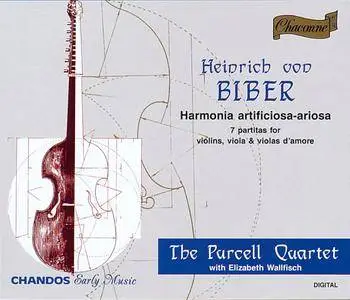
    The Purcell Quartet with Elizabeth Wallfisch - Heinrich Ignaz Franz von Biber: Harmonia artificiosa ariosa (1994) 2CDs

    Posted By: Designol
    The Purcell Quartet with Elizabeth Wallfisch - Heinrich Ignaz Franz von Biber: Harmonia artificiosa ariosa (1994) 2CDs

    Heinrich Ignaz Franz von Biber: Harmonia artificiosa ariosa (1994) 2CDs
    The Purcell Quartet with Elizabeth Wallfisch (viola d`amore)

    EAC | FLAC | Image (Cue&Log) ~ 429 Mb | Scans included
    Classical, Baroque | Label: Chandos | # CHAN0575/6 | Time: 01:30:22

    Like many of his German and Austrian contemporaries, Bohemian-born composer Heinrich von Biber was strongly influenced by the Italian school of violin composition that included Biagio Marini (1587-1665) and Marco Uccellini (1603-1680). A noted virtuoso himself, Biber and his teacher Johann Heinrich Schmelzer (1621-1680) were two of the most important figures of the late seventeenth-century Viennese violin style. Biber's keen understanding of the technical and expressive possibilities of the instrument is evident in his innovative use of pizzicato (plucking of the string with the finger), double and triple stops (more than one note played at once creating "chords"), col legno (stick of the bow on the string), sul ponticello (played close to the bridge), and, especially, scordatura (intentional "mistuning" of the strings). Scordatura allowed the performer to play chords in particular keys more easily, extended the range of notes, and provided more open strings in order to negotiate the difficulty of polyphonic writing for a single instrument. Biber's imaginative and original use of these techniques or special effects brought violin virtuosity to an entirely new level of musical expression in the Baroque period. It can be argued that J. S. Bach's masterful Sonatas and Partitas for Solo Violin, written in 1720, are direct descendants of Biber's grounding breaking Mystery or Rosary Sonatas, composed nearly a quarter of a century earlier.

    Andrew Manze, Richard Egarr - Heinrich Ignaz Franz von Biber: The Rosary Sonatas (2004)

    Posted By: ArlegZ
    Andrew Manze, Richard Egarr - Heinrich Ignaz Franz von Biber: The Rosary Sonatas (2004)

    Andrew Manze, Richard Egarr - Heinrich Ignaz Franz von Biber: The Rosary Sonatas (2004)
    EAC | FLAC | Image (Cue & Log) ~ 688 Mb | Total time: 72:35+68:56 | Scans included
    Classical | Label: Harmonia Mundi | HMU 907321.22 | Recorded: 2003

    "Les Sonates du Rosaire" forment l'un des cycles les plus originaux jamais composés pour le violon et qui fit la célébrité de Biber jusqu'à nos jours. Utilisant un accord du violon différent (scordatura) dans chacune de ses 15 sonates - toutes interprétées sur le même instrument d'Amati -, ce cycle représente le sommet de l'invention baroque et du style virtuose du XVIIe siècle. Distingué par un Gramophone Award, le duo Andrew Manze - Richard Egarr relève ce défi de manière éblouissante. Andrew Manze joue sur un violon Amati, 1700 ; archet de Gerhard Landwehr, Heemstede, 1988 d'après un modèle italien. Ce titre est paru pour la première fois en 2004.

    Deutsche Harmonia Mundi - 100 Great Recordings, Part 1 (2017)

    Posted By: ArlegZ
    Deutsche Harmonia Mundi - 100 Great Recordings, Part 1 (2017)

    Deutsche Harmonia Mundi - 100 Great Recordings, Part 1 (2017)
    EAC | FLAC | Image (Cue & Log) ~ 7,18 Gb | Scans included
    Classical | Label: Deutsche Harmonia Mundi | # 19075800702 | Recorded: 1960-2013

    Since it's founding in Freiburg in 1958, Deutsche Harmonia Mundi has been one of the most important and ambitious labels for period performances. Over decades, globally-acclaimed recordings were created with outstanding musicians. The limited edition "Deutsche Harmonia Mundi: 100 Great Recordings" contains 100 outstanding DHM recordings with some of the most important and best artists in their field: Nuria Rial, Dorothee Mields, Al Ayre Espanol, Hille Perl, Concentus Musicus Wien, Nikolaus Harnoncourt, the Freiburger Barockorchester, Skip Sempé, Capriccio Stravagante, La Petite Bande, Gustav Leonhardt, Andrew Lawrence-King, Frieder Bernius, the Balthasar-Neumann-Chor, Thomas Hengelbrock and many others.

    Roy Goodman, Peter Holman, The Parley of Instruments - Heinrich Ignaz Franz von Biber: Twelve Sonatas (1987)

    Posted By: ArlegZ
    Roy Goodman, Peter Holman, The Parley of Instruments - Heinrich Ignaz Franz von Biber: Twelve Sonatas (1987)

    Roy Goodman, Peter Holman, The Parley of Instruments - Heinrich Ignaz Franz von Biber: Twelve Sonatas for trumpets, strings, timpani and continuo (1987)
    XLD | FLAC | Image (Cue & Log) ~ 365 Mb | Total time: 59:34 | Scans included
    Classical | Label: Hyperion | CDA 66145 | Recorded: 1983

    For much of the Baroque period, there was no useful distinction between orchestral and chamber music. All music, unless performed in church or on some festive occasion, was cultivated in the home, and even the concertos of Vivaldi and Bach rarely require more than a dozen people for an adequate performance. These "sonatas," which consist of single movement compositions with several linked sections, variously employ violins, violas, trumpets (and drums), cellos and continuo instruments (harpsichord, organ, lute). Biber had a unique ability to come up with catchy tunes and arrange them in formally satisfying way. The music is brilliant and consistently engaging. So are these performances.

    Gunar Letzbor, Ars Antiqua Austria - Heinrich Ignaz Franz von Biber: Rosenkranzsonaten (2020)

    Posted By: ArlegZ
    Gunar Letzbor, Ars Antiqua Austria - Heinrich Ignaz Franz von Biber: Rosenkranzsonaten (2020)

    Gunar Letzbor, Ars Antiqua Austria - Heinrich Ignaz Franz von Biber: Rosenkranzsonaten (2020)
    EAC | FLAC | Image (Cue & Log) ~ 711 Mb | Total time: 79:51+62:44 | Scans included
    Classical | Label: Pan Classics | # PAN 10409 | Recorded: 2019

    Eduard Melkus brought Heinrich Ignaz Franz Biber's (1644-1704) Rosary Sonatas (Rosenkranzsonaten) to new life with his groundbreaking 1967 recording; in the six decades that have passed since then, the pieces, which are as virtuoso as they are meditative in mood, have conquered a firm place in the discographies of ambitious baroque violinists. The Austrian violinist Gunar Letzbor has been considered one of the leading interpreters of this famous cycle since he recorded his interpretation on album for the Arcana label in 1996. The success was overwhelming: the critics were enthusiastic and the recording is still today available in the label's catalogue.

    Romanesca - Heinrich Ignaz Franz von Biber: Violin Sonatas (1994)

    Posted By: ArlegZ
    Romanesca - Heinrich Ignaz Franz von Biber: Violin Sonatas (1994)

    Romanesca - Heinrich Ignaz Franz von Biber: Violin Sonatas (1994)
    XLD | FLAC | Image (Cue & Log) ~ 624 Mb | Total time: 65:46+61:15 | Scans included
    Classical | Label: Harmonia Mundi ‎| HMU 907134.35 | Recorded: 1993-1994

    While the more famous Mystery Sonatas have quickly found friends, the 1681 set is still largely unknown. Yet what's immediately noticeable from this premiere recording of the sonatas is that Biber isn't only a legendary virtuoso, probably never bettered in the 17th or 18th centuries, but one of the most inventive composers of his age: bold and exciting, certainly, but also elusive, mercurial and mysterious. Most of the works are preludes, arias and variations of an unregulated nature: improvisatory preludes over naked pedals and lucid arias juxtaposing with eccentric rhetorical conceits are mixed up in an unpredictable phantasm of contrast, and yet at its best it all adds up to a unified structure of considerable potency.